I can’t even remember the last time I read a book from cover to cover. I haven’t dared to buy myself a book for the same reason in a while. My Kindle died a natural death a year back. I never got around to replacing it because I wasn’t sure if reading would ever come back to me.
Recently I’ve had discussions with childhood friends who used to be avid readers, lost it for a while, and got back to it with intentional effort — and with those who have moved out of the country and found it difficult to read in their mother tongue, but caught up with reading again. Meanwhile, I watched Santhosh reading a lot of technical books recently. I did try to flip through the pages, but I wasn’t hooked. I didn’t know what my fate with reading would be. I wasn’t bothered either.
This birthday, I was gifted Arundhati Roy’s മദർ മേരി Comes to Me by my husband — the Malayalam translation by Nayanathara N G. It was special in many ways. The moment I knew the translation was by Nayanathara, I had high hopes, and I did mention it to him at home. We rarely buy things for each other, simply because we’re not into owning ’things’ (if books count as things). I haven’t asked what tempted him to buy this, but I enjoyed receiving it. It was special again as it was an author-signed copy.
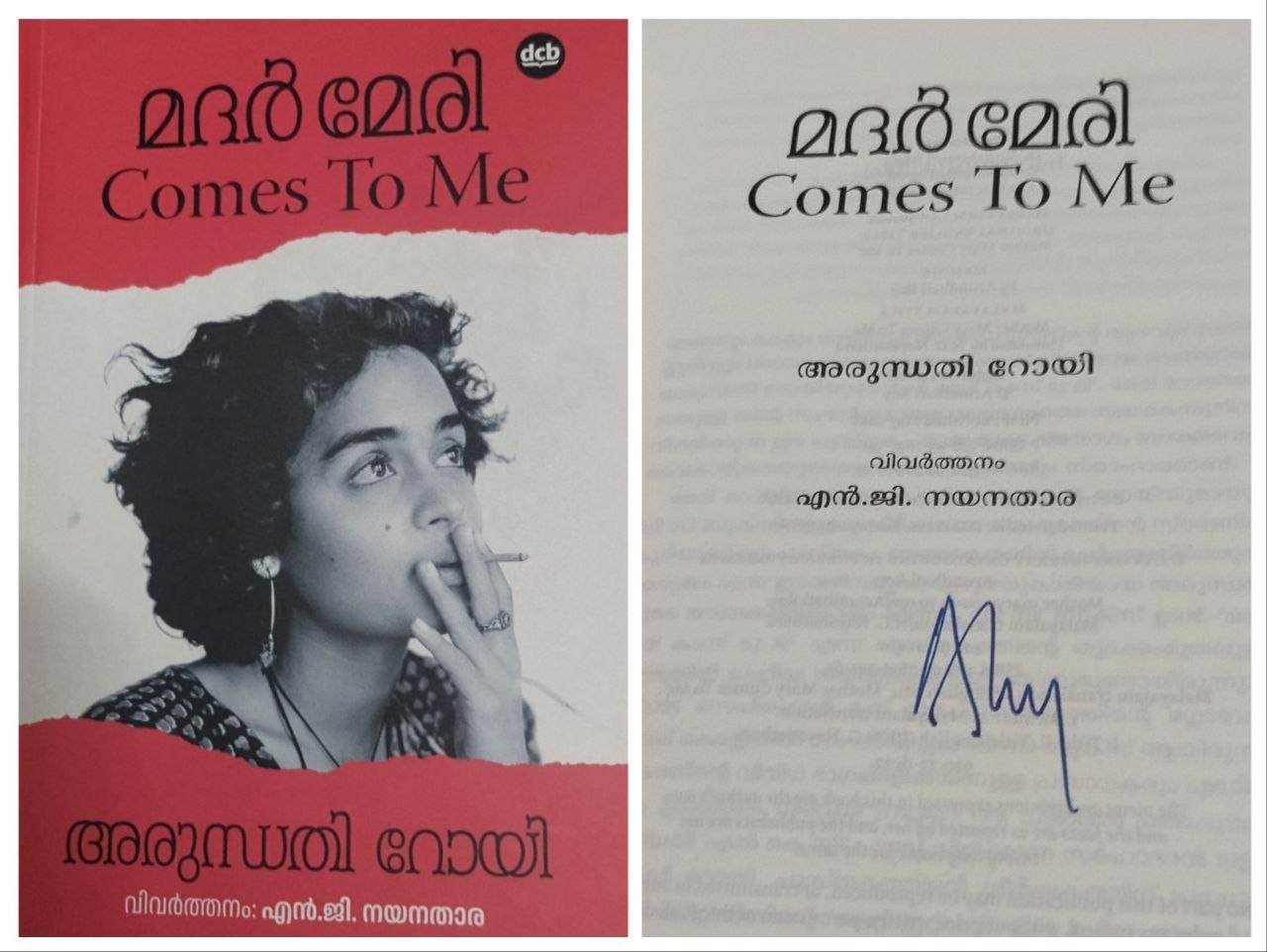
I was instantly hooked. I couldn’t do anything but read. The emotional connection was deep. I cried through the first few chapters the night I started it. Arundhati, at sixteen, striking out alone into an unknown city, into an unknown life. I have read many such Malayalam fictions. Young people leaving, finding themselves, losing themselves. But the protagonist was always a man. Here was a real woman that story had actually happened to. Life stranger than fiction, because fiction hadn’t dared to imagine her.
They call it a memoir, but it was more than that — it was a biography of a woman and an autobiography of the author. The evolution of the author as a political being, seen through her own lens, was fascinating. I couldn’t stop thinking about the author’s remarkable craft of narrating the story of both their eventful lives in a detached yet deeply honest manner.
It did stir some memories — my own relationship with my mother, and her relationship with my grandmother. I have always tried to find explanations for why they behaved certain ways at certain points in their lives. My mother was raised by a single mother, in a city close to where Arundhati Roy grew up, in the same years Mary Roy was living her own eventful life. My grandmother was a teacher too. The separation was not something that happened to her - it was something she decided. Strangely, these are things I heard from people I knew, but never spoken directly to me.
The book reiterates that the laws of the ordinary do not apply to individuals in extraordinary circumstances. I could draw strong parallels between the mothers I had known, though the scales were vastly different. So it felt personal in many dimensions.
I can’t wrap this up without mentioning the translation by Nayanathara N G. It was so smooth and natural that I didn’t even notice it was a translation. But I intentionally paused at times to appreciate the choice of words. One thing that struck me was the decision to keep some English words as transliterations — right from the title and through the book — rather than reaching for Malayalam equivalents that would have felt unnatural. It is the work of a thoughtful translator - not merely something technically correct but entirely lifeless. I now long to read the original English version as well.
I feel immense gratitude to everyone involved in giving me this experience. I am a slightly different person than I was yesterday.